
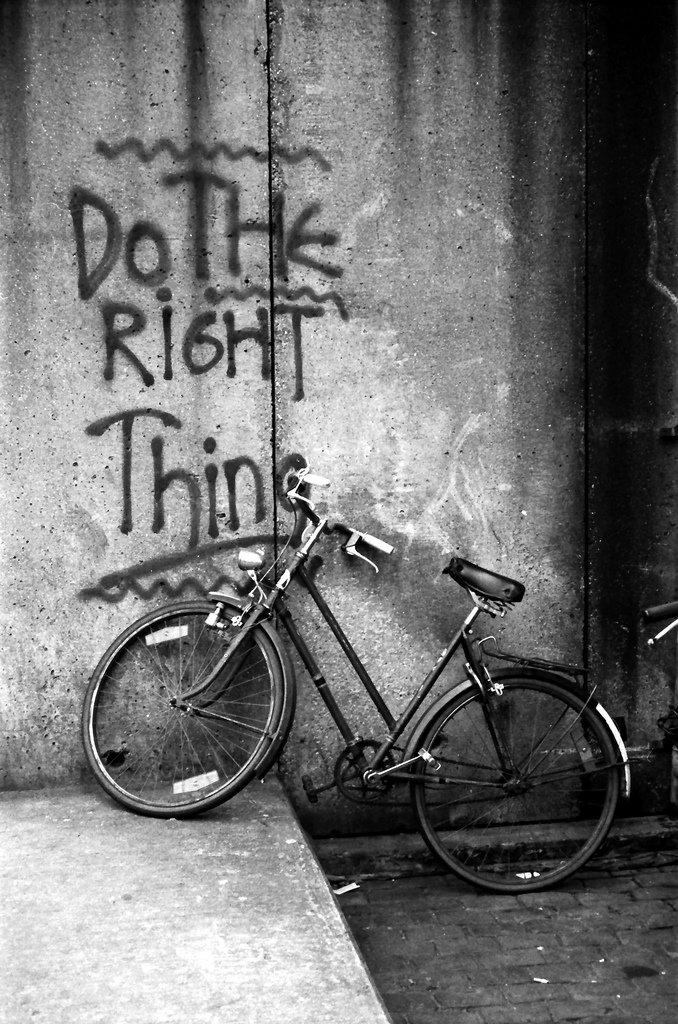
Do the Right Thing
A film about racial tension on a hot summer day.

Mouryan · CC BY-SA 4.0
The story explores a Brooklyn neighborhood's simmering racial tension between its African-American residents and the Italian-American owners of a local pizzeria, culminating in tragedy and violence on a hot summer's day.
- director
- Spike Lee
- genre
- Comedy-drama
- production_budget
- $6.2 million
- worldwide_gross
- $37.3 million
- academy_award_nominations
- Best Original Screenplay, Best Supporting Actor (Danny Aiello)
Lore & Background
This incident involved an attack on African-American men in a predominantly Italian-American neighborhood, resulting in one victim being struck by a car and killed. Lee was also influenced by the Alfred Hitchcock Presents episode 'Shopping for Death' and the killing of Eleanor Bumpurs by police. He wrote the screenplay in two weeks. The original script ended with a stronger reconciliation between Mookie and Sal, but Lee changed it; his notes indicate Lisa Jones expressed Sal's reaction as 'too nice' as originally written.
Reader's Guide
Do the Right Thing earned nominations for Best Original Screenplay and Best Supporting Actor (Aiello) at the 62nd Academy Awards. The film's ambiguous and controversial conclusion sparked widespread debate upon release regarding the nature of protest, responsibility and moral judgment. Blending elements of comedy, drama and social commentary, the film is noted for its vivid color design, stylized cinematography, direct-address monologues and an influential hip-hop-driven soundtrack, prominently featuring Public Enemy's 'Fight the Power'.
Did You Know?
- The film is the feature film debut of Martin Lawrence and Rosie Perez.
- Samuel L. Jackson played the role of Mister Señor Love Daddy.
- Roger Guenveur Smith created the character of Smiley, who was not in the original script.
- The film's epilogue shows quotations from Martin Luther King Jr. and Malcolm X.
From Stage to Screen
His stated ambition was to craft a hopeful, happy-ending narrative about being gay, being working class, and coming out. He was driven by a gap he noticed on television: heterosexual teenagers could watch the 'gorgeous guy taking the gorgeous girl to the prom,' yet no comparable role model existed for queer youth. Producer Tony Garnett felt the material translated better to the screen than the stage, and once Channel 4 greenlit the production, David Aukin, the channel's head of drama, brought in stage director Hettie MacDonald to helm the project because the subject matter felt 'foreign' to Garnett. The finished film marked the cinema debuts of Harvey, MacDonald, and actors Glen Berry, Scott Neal, and Tameka Empson.
A Story Set in Thamesmead
The narrative centers on Jamie Gangel, an introverted teenager on a council estate in Thamesmead, south-east London, who is picked on by classmates for his dislike of football. His single mother Sandra is consumed by ambitions to run her own pub and cycles through lovers, most recently a neo-hippie named Tony. Jamie harbors a secret attraction to his neighbor Ste Pearce, a boy regularly beaten by his drug-dealing older brother and alcoholic father. After one such beating, Sandra lets Ste sleep over, and the two end up sharing a bed head-to-toe. On their second night, Jamie applies peppermint lotion to Ste's bruised back, and after learning Ste has never been kissed, Jamie gives him his first. The relationship faces obstacles including a hostile house party, Sandra's discovery of a stolen Gay Times magazine and vandalized schoolbooks, and a confrontation that ultimately leads to her acceptance. The story culminates in the two boys sharing a slow dance in their estate's courtyard to Cass Elliot's 'Dream a Little Dream of Me.'
Production Challenges and On-Set Anecdotes
The production was not without friction. Harvey recalled that the two boys were originally intended to be 15 and 16, but since those ages fell below the age of consent in Britain, the cast was auditioned at 17. Lawyers had to scrutinize the project because of an on-screen kiss, and ultimately all references to specific ages were removed—not for legal reasons, but because Gay Times objected to their magazine appearing in a film that mentioned the characters being underage. On set, first assistant director Susie Liggat recounted that electricians flatly refused to work during the scenes where Jamie and Ste kiss in the woods after leaving The Gloucester pub. A compromise was reached: the electricians would rig the lights and then leave before filming began. Liggat and Harvey both took small uncredited roles; Liggat played a woman at the newsstand, while Harvey appeared as 'Wheelchair Queen' in the Gloucester scene.
Legacy and Audience Impact
The film has since been ranked among the finest LGBTQ cinema, and its atmosphere is shaped by a soundtrack drawn almost entirely from the Mamas & the Papas and Cass Elliot. Producer Tony Garnett recalled the flood of letters that arrived after release, written by young men who thanked the filmmakers for 'saving them,' saying they now knew they were not alone or freaks. In 2016, British playwright Fin Kennedy observed that two decades on, the story was still held in 'near-universal affection among audiences.' The film also left a tangible mark on the drag community: Dave Lynn, who played the performer at The Gloucester, was already a regular act there and was asked on set to appear. He later donated the dress he wore in the film for display at a bar in Brighton, alongside a copy of the script.
Gallery



More in Notable Films 1-21
Spotted an error? Know more?
This is a living reference — every entry is fact-audited, and reader corrections feed straight into our audit queue. Suggest an edit · See this site's audit record