
Blue Velvet (film)

Umberto Montiroli · Public domain
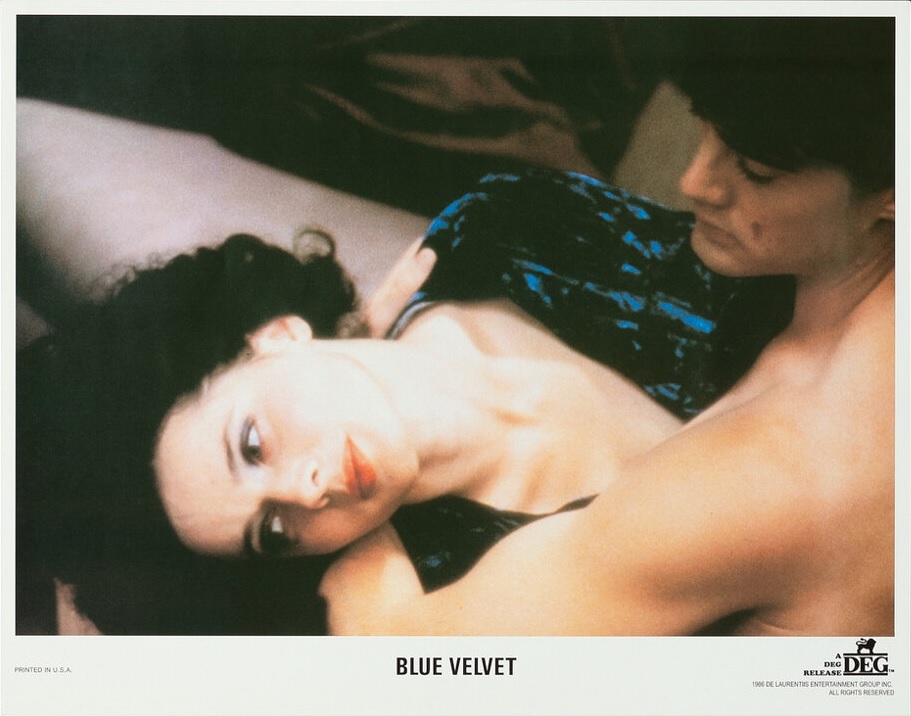
It follows a college student who returns to his hometown, discovers a severed human ear in a field, and uncovers a criminal conspiracy involving a troubled nightclub singer.
- Director
- David Lynch
- Genre
- Neo-noir mystery thriller
- Production company
- De Laurentiis Entertainment Group
- Budget
- $6 million
- Notable cast
- Kyle MacLachlan, Isabella Rossellini, Dennis Hopper, Laura Dern
Lore & Background
After completing The Elephant Man, Lynch met producer Richard Roth, who asked if he had any scripts; Lynch shared an idea about sneaking into a girl's room to watch her and seeing a clue to a murder mystery. Roth asked him to write a treatment, and Lynch thought of the ear in the field. Lynch wrote two more drafts before he was satisfied, noting that earlier drafts had 'all the unpleasantness in the film but nothing else.'
Reader's Guide
Blue Velvet initially received a divided critical response, with many stating that its explicit content served little artistic purpose. Nevertheless, the film earned Lynch his second nomination for the Academy Award for Best Director, and received the year's Best Film and Best Director prizes from the National Society of Film Critics. It came to achieve cult status. As an example of a director casting against the norm, it was credited for revitalizing Hopper's career and for providing Rossellini with a dramatic outlet beyond her previous work as a fashion model and a cosmetics spokeswoman. In the years since, the film has been re-evaluated and is widely regarded as one of Lynch's masterpieces, frequently cited as one of the greatest films of the 1980s. Publications including Sight and Sound, Time, Entertainment Weekly, and BBC Magazine have ranked it among the greatest American films of all time.
Did You Know?
- Lynch's screenplay had been passed around multiple times in the late 1970s and early 1980s, with several major studios declining it due to its strong sexual and violent content.
- The independent studio De Laurentiis Entertainment Group, owned by Italian film producer Dino De Laurentiis, agreed to finance and produce the film.
- The scene of Dorothy appearing naked outside was inspired by a real-life experience Lynch had during childhood when he and his brother saw a naked woman walking down a neighborhood street at night.
Scope and Genre Boundaries
The collection centers on a specific niche of French cinema: softcore erotic films and sex comedy productions. Rather than encompassing the entirety of French filmmaking, the list deliberately narrows its focus to these two overlapping genres, capturing works that blend explicit content with comedic or narrative storytelling. The inclusion of co-productions alongside purely French productions broadens the scope, acknowledging that the French erotic film tradition was not always a solitary national endeavor but sometimes involved international collaboration. This categorization reflects a filmmaking tradition where erotic content and humor were treated as complementary rather than contradictory elements, producing a body of work that occupies a distinct space within French popular cinema. The list serves as a curated index of the most notable entries within this specific genre, distinguishing them from the broader landscape of French film production and offering a focused window into a particular creative sensibility.
The Reference Dictionary and Film Formats
A key scholarly resource underpinning this field is the Dictionnaire des films français pornographiques et érotiques en 16 et 35 mm, published by Serious Publishing in 2011. Directed by Christophe Bier, this dictionary represents a systematic attempt to catalog and document French erotic and pornographic cinema across two distinct film formats: 16 millimeter and 35 millimeter. The distinction between these gauges is significant, as 16mm was historically associated with lower-budget, more experimental, or underground productions, while 35mm was the standard for theatrical releases and more established studio work. By encompassing both formats, Bier's reference work acknowledges the full spectrum of French erotic filmmaking, from modest independent productions to larger-scale theatrical releases. The 2011 publication date suggests a retrospective effort to preserve and organize a body of work that might otherwise risk being forgotten or scattered across various archives and private collections.
Curatorial Judgment and Notability
The list is explicitly framed as a compilation of the most notable works within the French softcore erotic and sex comedy genres. This qualifier of notability implies a curatorial judgment has been applied, distinguishing landmark or culturally significant productions from the sheer volume of films that fall under these genre labels. Not all French erotic or sex comedy films are included; rather, the selection represents those works that have achieved a particular standing within the genre, whether through critical recognition, cultural impact, or enduring popularity. The co-production aspect further complicates the notion of notability, as some of the most significant works in this space may have been created through international partnerships, blending French sensibilities with other national traditions. The list thus functions not merely as a comprehensive inventory but as a guided tour through the highlights of a specific cinematic tradition, offering readers a starting point for exploring the most important works in French erotic and comedic filmmaking.
Continuity Across Eras
Among the broader references associated with this field is the concept of pairing unforgettable French erotic movies from both old and new periods, a framing that suggests a continuity between different eras of French erotic filmmaking. The juxtaposition of older and newer works implies that the tradition has evolved across decades while maintaining certain recognizable qualities that allow productions from different periods to be discussed in the same breath. This temporal pairing highlights that French erotic cinema is not a static or period-bound phenomenon but a living tradition that has produced memorable works across multiple generations. The emphasis on works being unforgettable underscores the lasting cultural imprint of certain productions, suggesting that specific films have transcended their genre to become reference points in popular culture. Together with the comprehensive dictionary and the curated list of notable works, these references paint a picture of a filmmaking tradition that, while niche, has been taken seriously enough to warrant dedicated scholarship, systematic cataloging, and ongoing cultural discussion.
Gallery




More in Notable Films 1-21
Spotted an error? Know more?
This is a living reference — every entry is fact-audited, and reader corrections feed straight into our audit queue. Suggest an edit · See this site's audit record